
A Quiet Walk Through Rochester
A gentle circular walk through quiet streets, green spaces and river views, revealing how Rochester fits together beyond the High Street.
A gentle circular walk that reveals Rochester as locals experience it. Not just through its celebrated High Street, but through the quieter back streets, hidden green spaces and viewpoints that give the town its depth. In just over an hour, this route traces the relationship between river, hill, power and modern daily life, passing many of Rochester’s most significant historic sites while allowing time to explore, pause and observe.
Historic Rochester is often described as small. In truth, it is compact. It’s a place where centuries of history sits close together, layered rather than spread out. This walk makes that density easier to navigate. It begins and ends beside the Medway, the real reason the town exists, before moving through residential streets, school precincts, parks and the independent heart of the High Street, finally returning to open space and water.
The Threshold: River & Bridge
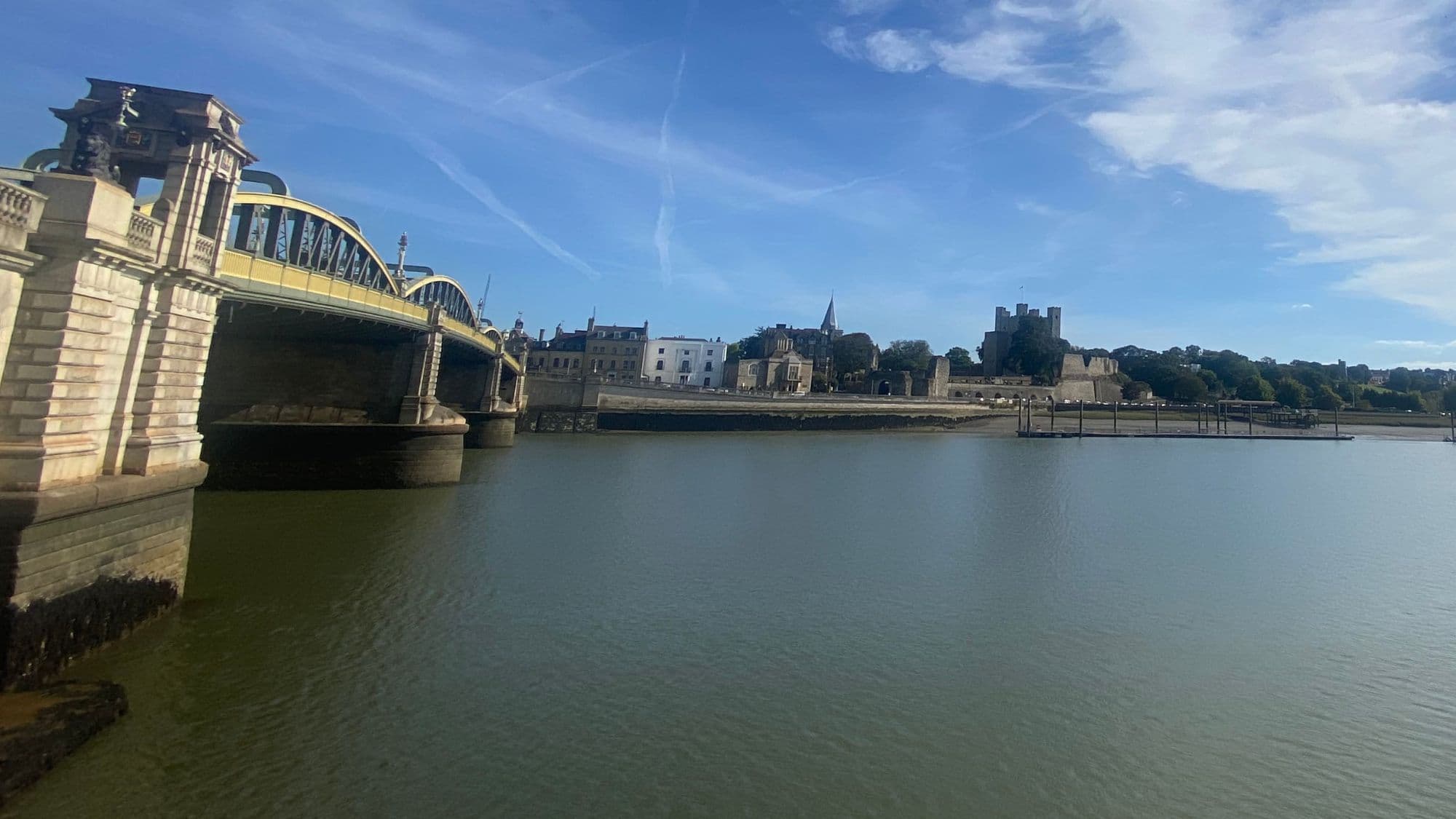
Begin at Rochester Bridge or the adjoining Esplanade. This is the town’s natural threshold: wide sky, moving water, and the unmistakable silhouette of castle keep and cathedral tower rise above on the opposite side of the road. The bridge has carried traffic across the Medway since Roman times, linking London with the south-east coast. Standing here, the strategic importance of the bridge becomes immediately clear.
Follow the river path towards the Esplanade gardens. On warmer days families gather on the grass, children drift between playground and water’s edge, dog walkers and joggers trace the curve of the river. Boats and small yachts rise and gently fall with the tide, the movement of the river sets the rhythm defining this part of Rochester. When the sun is high, the scene can feel unexpectedly continental: bright, open, almost coastal.
If open, the Victorian pier offers an excellent vantage point, allowing views both upstream and downstream. Turn back and walk towards the castle wall, cross carefully, and make your way inland via Baker’s Walk.
Rising Above the River: Boley Hill
The short ascent via Baker's Walk to Boley Hill, introduces one of Rochester’s most appealing contrasts: a residential enclave set immediately beside monumental history. To the right, stands grand walled and gated historic houses; to the other, beyond the high walls and greenery, lies the castle grounds and the cathedral precinct.
Pause to look back towards the river. From this slightly elevated position the yachts appear suspended on the water, framed by the wide Medway and distant marshland at low tide. It is an unexpectedly serene viewpoint and so close to the town centre.
Continue, turn right and walk along St Margaret’s Road. Further along stands The Coopers Arms, reputedly one of the oldest pubs in Kent. Its modest exterior gives little hint of the centuries of local stories attached to it. The landlords are often happy to share stories of the pub’s history with tales of a resident monk said to linger. Whether taken as history, folklore or simply part of the atmosphere, these stories reinforce the sense that time here has never quite moved on.
Cathedral Precinct & Kings School Buildings
Return back toward Boley Hill and walk beside the castle’s dry moat. From this angle the keep appears suddenly immense, its scale difficult to grasp from ground level elsewhere. As you continue, Rochester Cathedral reveals itself opposite, its steeple rising above.
Cross over the road and once in front of the Cathedral turn right and follow the curve of the road, to the left, past railings that offer glimpses into the cathedral gardens. The garden space feels both secluded, deeply historic and often busy during warmer months. Minor Canon Row, with its elegant Georgian terraces dating from the early eighteenth century, provides one of the finest surviving examples of domestic architecture in Rochester. The houses, modest in scale but carefully proportioned, speak of a long-established community rather than a museum piece.
Much of the buildings in this area belong to the King’s School, one of the oldest continuously operating schools in England. Students moving between buildings, sports grounds and classrooms bring a sense of continuity to surroundings that might otherwise feel frozen in time.
The Vines & Restoration House
Continue into the Vines Gardens, a quiet green oasis originally associated with monastic vineyards. Today it serves as a peaceful pause: a place where dog walkers, students and residents share the open lawn beneath mature trees.
From here, follow the path to steps leading down to Crow Lane, where Restoration House stands prominently ahead. Its architectural grandeur reflects its royal associations: King Charles II stayed here on the eve of the Restoration in 1660. The house later inspired Charles Dickens, who lived in nearby Gad’s Hill and often walked these streets. Though grand, it remains part of an ordinary residential setting, reinforcing the sense that Rochester’s history is embedded in everyday life rather than separated from it. Later owners included television entertainer Rod Hull, a reminder that even the grandest houses here continue to be lived in rather than preserved behind glass.
The Everyday Town: High Street Life
Turning left and the walk up Crow Lane brings you onto Rochester High Street, the social and commercial spine of the town. Opposite stands Eastgate House with Charles Dickens Chalet in the rear walled garden, two historic landmarks set amongst shops and businesses.
Here the pace shifts. Independent retailers, cafés and long-established businesses create a sense of continuity rarely found on modern high streets. Residents move between shops and conversations; visitors browse slowly rather than rushing. Empire’s distinctive menswear, specialist bookshops, greengrocers and cafés coexist comfortably, each occupying buildings that are centuries old.
Look upward as you walk. Decorative gables, timber framing and rooflines tell as much of the story as the shopfronts below. Plaques on many buildings quietly record their histories and reward those who pause long enough to read them.
Long-standing cafés, including Lenny’s of Rochester, provide natural places to pause for coffee or lunch, whether for a quick rest or a more unhurried interlude before moving on.
A Moment of Pause: Castle & Cathedral
As the High Street flows back toward the cathedral, the medieval Deanery Gate marks the entrance to one of Rochester’s most atmospheric spaces. Nearby pubs and restaurants offer views directly over the castle grounds: a reminder that in this town even ordinary refreshment stops take place in extraordinary surroundings.
Continue up the hill into Rochester Castle Gardens. On warm days the lawns fill with picnickers, students and families, while others sit quietly observing the river on benches along the river side wall. The massive stone keep dominates the scene, its presence both imposing and oddly reassuring, as if anchoring the landscape.
The Return: River & Reflection
From the gardens, paths lead naturally back down steps and through the arch, toward the river where the walk began. Seen again after the circuit, the Medway feels less like a backdrop and more like the organising force behind everything you have just experienced. Trade, defence, religion, education and daily life all radiate from this crossing point.
This is an ideal place to pause before leaving. Sit on the grass, watch the movement of boats and people, or simply take in the view of the castle against the sky. The route’s circular nature reinforces the sense of completeness: a walk that begins and ends with water, having passed through centuries of history condensed into a remarkably small space.
Rochester reveals itself slowly. This quiet loop does not attempt to show everything, but it offers a deeper understanding of how the town fits together: not as a collection of attractions, but as a lived landscape shaped by river, power, community and time.