
Inside Cobham Hall: The Storied Interiors of a Kentish Masterpiece
Glimpse inside Cobham Hall, one of Kent’s grandest historic homes. Its interiors reveal centuries of artistry, aristocracy and quietly magnificent craftsmanship.
Hidden among sweeping parkland and ancient trees, Cobham Hall is a Grade I, 16th-century mansion house and now a boarding school that immediately commands attention. Once inside, its true character reveals itself. The interiors unfold room by room, each space shaped by families such as the de Cobhams, the Brookes, and the Blighs, who lived, entertained, planned, and dreamed within its walls.
The Gilt Hall sets the tone. Sunlight moves across gold-leaf detailing, catching on ornate plasterwork, and tall windows frame the grounds like paintings. Yellow scagliola marble columns give the room its formality and scale. It was built to impress, and centuries later it still carries that sense of ceremony. The space was designed for music, movement, and gathering, with its decorated ceiling lifting the eye and the polished floor drawing you through the room.
Nearby, the Long Gallery stretches out in careful symmetry, lined with portraits that look down with quiet watchfulness. Historically, it appears to have been used for conversation around the large fireplace during colder months. Today it serves as the school library, but it still feels more like a promenade than a reading room. Its length encourages slow movement, and its details reward attention: single-paned windows softened by age, a delicately carved fireplace, and surfaces shaped by centuries of use.
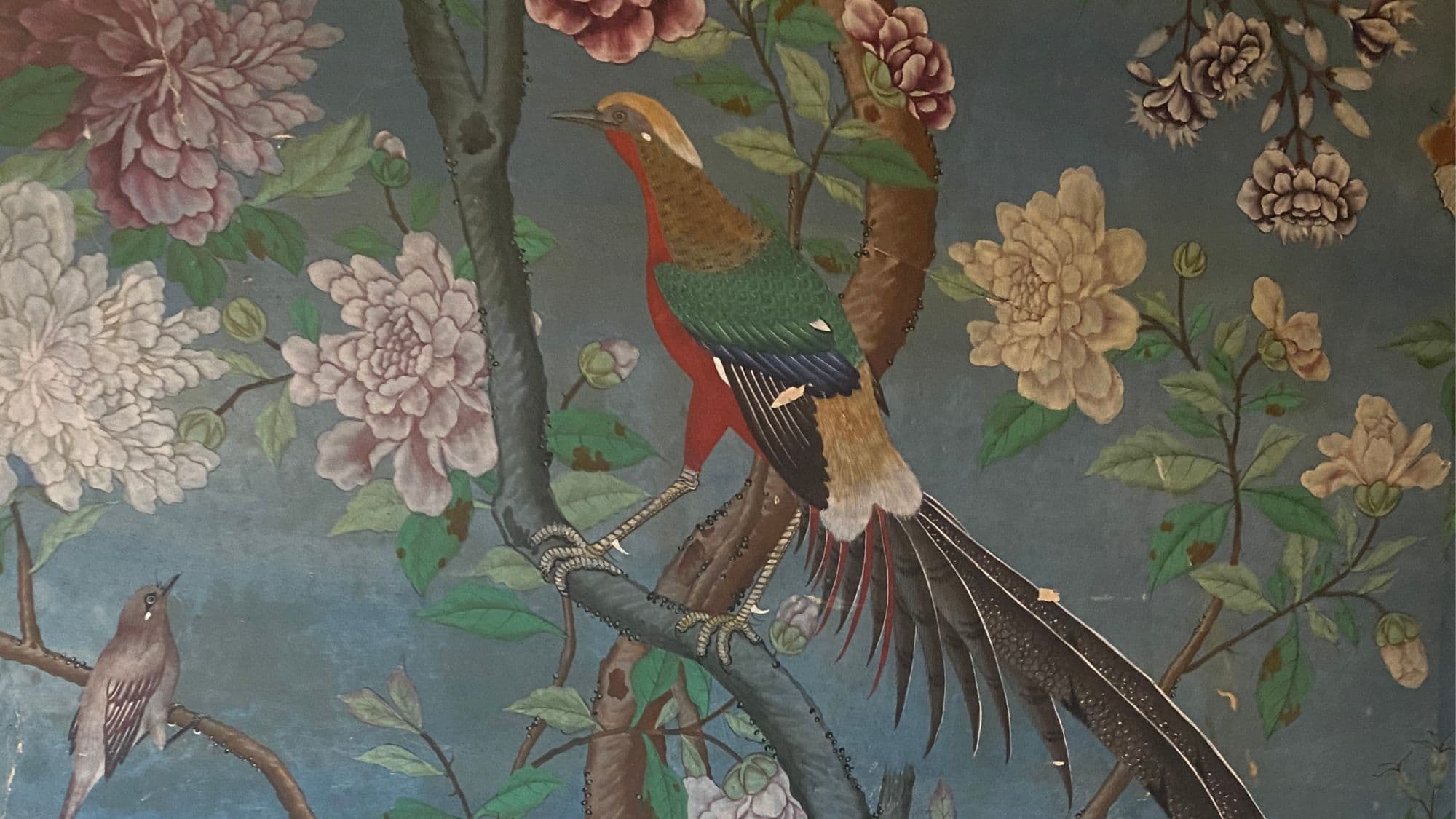
Not every room is defined by grandeur. Some of the house’s strongest moments come from its quieter spaces. Smaller chambers sit in low light with rich wallpapers and muted colour, and each room carries the scent and texture of age. These spaces suggest everyday life as much as ceremony. They show the building not just as a statement of power or design, but as a lived home, layered with personal histories.
The chapel offers a calmer form of splendour. Its stillness and simplicity feel deliberate, creating a space shaped for reflection. Elsewhere, the staircases show the same level of craftsmanship. Their sweeping curves and carved woodwork were designed for measured entrances and formal movement. Even the corridors and landings carry decoration, showing that transitional spaces were given as much thought as the main rooms.
What makes Cobham Hall’s interiors particularly distinctive is the mix of architectural periods. Tudor strength sits alongside Jacobean richness and Georgian refinement. Rather than competing, these layers sit comfortably together, giving the house a sense of evolution rather than uniformity. The building feels shaped by time, not a locked time capsule.
Today, Cobham Hall continues to welcome visitors through guided tours that allow access to its main rooms. Both a school and a heritage site, it offers a rare chance to experience one of Kent’s finest historic houses from the inside. Walking through its rooms feels less like passing through a museum and more like moving through an unfolding record of domestic life, craftsmanship, and social change.
Cobham Hall is not only impressive for its scale and gardens. Its true understanding lies in its rooms, where architecture and lived experience remain closely intertwined.
Cobham Hall opens for guided tours on selected dates during the year. Visiting times and booking details can be found on the official website.
Website: cobhamhall.com